Token Exchange⚓︎
This document collects information about Token Exchange (RFC 8693), its support by Keycloak and potential use cases that can be supported using Token Exchange or related features.
Keycloak’s Legacy Token Exchange feature (V1) is explicitly not taken into consideration. Only Token Exchange V2 and related features are considered. The reference Keycloak version is 26.5.6 unless noted otherwise.
Token Audience⚓︎
Controlling the audience of tokens is one of the main applications of token exchange. It is primarily used to improve security.
Security Considerations⚓︎
The audience of a token is mostly relevant for security.
A service should only accept tokens that it has obtained itself
(azp set to the requesting client) or that is intended to
be consumed by it (aud includes the target client).
Furthermore, tokens that are passed from one service to another should have minimal audience, so that only the target service can consume them.
The reason for this is shown in the following figure. It compares the simple way of passing around a token with full audience (aka “poor man’s delegation”) with an approach that uses token exchange and passes tokens with minimal audience.
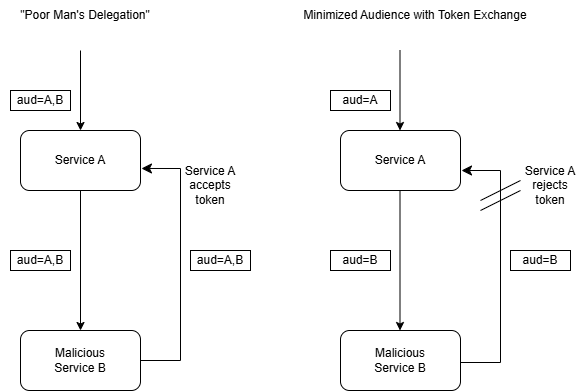
Suppose a user calls a rather powerful Service A that internally uses a less powerful Service B. Now suppose that Service B has been compromised and intends to misuse Service A.
In case of poor man’s delegation, the same token is used everywhere, and this token allows using both Service A and Service B. So Service B can easily use the token it receives from Service A to make malicious calls to Service A. BTW, this setup would also allow the user to call Service B directly, which may not be desired either.
In case of the minimum audience approach both is impossible. Service A receives a token that is only addressed to it and cannot be used to call Service B. It exchanges this token for one that addresses only Service B and passes it to Service B. If Service B tries to use this token to call Service A, Service A rejects it. An attempt of Service B to exchange the token for one that is addressed to Service A would be rejected unless Service B is explicitly granted permission to obtain tokens with Service A as audience.
So the minimum audience approach effectively prevents malicious services (ur users) to use services that they are not supposed to use, thus minimizing potential damage.
Audience Handling⚓︎
Each client should be configured to create initial access tokens with minimal audience (ideally only a single client ID). Routes should be configured to accept only tokens whose audience includes the expected client. The OPA client and route as generated by the IAM-BB Helm chart can be taken as an example.
Tokens with another audience are typically issued seamlessly via the Authorization Code Flow (aka Standard Flow) in case of interactive access (H2M). For non-interactive access (M2M), the caller should request them explicitly via Token Exchange.
Observations⚓︎
- The APISIX
openid-connectplugin validates the audience if a token is presented explicitly via theAuthorizationheader. - The APISIX
openid-connectplugin does not validate the audience of a token that it retrieved itself via Authorization Code Flow. - So in the latter case, it simply passes a token with mismatched audience through to the backend and thus does not detect a misconfigured audience in the client.
- At least every instance of the
openid-connectplugin (typically every route, maybe unlessPluginConfigis involved - tbc) retrieves its own token. This ensures that only tokens from the configured client are passed to the backend. So, if the client is properly configured, the audience will be OK.
Delegation Scenarios⚓︎
This section describes the delegation scenarios identified for EOEPCA.
Processing⚓︎
Processing typically runs asynchronously in a deferred process. The process of setting up a processing request is thus decoupled from processing itself.
A processing request is typically set up within an interactive user session, or it is submitted via an API within a M2M session. In both cases, the session is typically short-lived, i.e., the user typically logs out after a while or the API call may have been made using a short-lived access token.
Hence processing itself cannot take place within the user session in which the request is created. Instead, it is triggered internally by the processing system when appropriate resources become available. The acting party is thus the processing system, which acts on behalf of the user.
Approach using delegation⚓︎
Delegation would be the natural and most appropriate approach to handle the processing scenario. During the request submission process, the User grants permission to the Processing System to execute the processing request on their behalf. While executing the processing request, the Processing System uses this permission to obtain a token that allows it to access external systems on the user’s behalf as needed.
This involves the following steps:
- The user logs into the Processing System’s frontend. During the
login process (or optionally later in a separate step), the user
is asked to permit the Processing System to call required
services on their behalf. This results in an access token with
the claim
may_actset to the Processing System’s ID. Note that the user’s consent is stored in Keycloak and need not be repeated on every login. - The user sets up and submits a processing request, which is accompanied by the access token created above. The Processing System frontend queues the request incl. the token.
- Some time later the Processing System backend decides to execute the processing request. Using the user’s token as the subject token and a token representing its own identity as the actor token, it requests a new access token from the IdP using token exchange. This token expresses that the Processing System is acting on behalf of the original user.
Note that Keycloak does not yet support delegation using token exchange. So the approach sketched above cannot currently be used with Keycloak.
Note: It is unclear if the access token may be expired when it is used as a subject token in token exchange. If it cannot be expired, the approach above may not work reliably, because it cannot be guaranteed that the access token is still valid or even that the original user session still exists when processing is triggered.
Approach using offline tokens⚓︎
A possible viable alternative to the delegation approach described above would be to use an offline token as the bridge between the frontend session and background execution of the processing request.
The flow would be quite similar as for the delegation scenario, but no actual delegation would take place.
- The user logs into the Processing System’s frontend. During the login process (or preferably later just before request submission), the frontend obtains an offline token for the user. So there finally is an initial plain access token and an additional offline token, which can be stored with the request. The audience of the offline token should be the backend of the Processing System. Note that the frontend should store the offline token and reuse it for further processing requests if it is still valid long enough.
- The user sets up and submits a processing request, which is accompanied by the offline token created above. The Processing System frontend queues the request incl. the token.
- Some time later the Processing System backend decides to execute
the processing request. Whenever external calls are required
during processing, the backend obtains an access token from the
offline token using
refresh_tokengrant and optionally exchanges it for an access token with proper audience. These access tokens do not express that the Processing System is acting on behalf of the original user, but only bear the original user’s identity. However, the fact that the Processing System was involved is still documented by theazpclaim.
A possible way to obtain an offline token is described here. Note that the offline token must be stored and managed by the frontend. It also needs to be renewed from time to time. In contrast, in the delegation case, the user’s consent would only have to be requested once and would then be managed by Keycloak.
Note that offline tokens and access tokens obtained from them cannot be exchanged for refresh tokens. This means that services called by the backend are not able to extend the lifetime of their session beyond the lifetime of the access token they receive. New access tokens can only be obtained from the original offline token, which the backend should not disclose.
Approach using M2M account⚓︎
At present, it is not foreseen that a processing job calls external services except the Workspace API, which it primarily consults to obtain storage credentials. Furthermore, it is not necessary to strictly preserve the user’s identity during processing, because the processing job is assigned to the user anyway. Thus the processing system already knows the user’s identity, whereas the Workspace API does not really need it to return storage credentials. It just requires a token that expresses permission to obtain them.
The current approach is therefore to use the processing system’s own identity only. The processing system creates an access token with reasonable lifetime, which allows the processing job to obtain storage credentials for the workspace(s) on which it operates. It then passes this token to the processing job, which may use it to call the Workspace API to obtain storage credentials.
Passing a token with the processing system’s identity to a user process may be a security risk. Therefore it is important to limit the access token to the absolute minimum. This means that the default scope of the M2M client represented by the access token should be as minimal as possible, and that no unnecessary optional scopes should be requested when obtaining the token. The audience of the token should be limited to the Workspace API. User roles should also be limited to the required minimum.
Ideally, a dedicated client should be used for this purpose. If this is not possible, the access token should at least be tailored through token exchange before being passed to the processing job.
This approach is suitable as long as processing jobs only access the Workspace API for “simple” purposes. It is not suitable if a processing job needs to access external services that insist on the user to prove their own identity.
Resource Health User Jobs⚓︎
Resource Health allows users to configure health check jobs that are executed regularly. These jobs typically execute user-provided code and are run on the user’s behalf. This is very similar to the Processing use case and basically subject to the same considerations.
The current implementation uses the offline token approach. The offline token and the access tokens obtained from it have a wide audience and can thus be used by the user code to call arbitrary services that the user has permissions for. The offline token is managed by Resource Health and never disclosed to the user code. Instead, the user code only gets a prepared access token with the same audience as the offline token.
In a way, this makes sense, because Resource Health does not necessarily know in advance which services the user code will call. So it cannot reasonably limit the token audience.
A possible security improvement could be to allow the user to configure the desired audience and scope of the access token that is passed to the user code. Resource Health could then provide a suitable, limited-audience and limited-scope access token using token exchange.
On the long run, it might also make sense to switch to the delegation approach to mitigate limitations of the offline token approach or improve the user’s comfort. However, on the one hand, at least access token lifetime limitations are not really an issue here, because the jobs typically run rather quickly. On the other hand, the long lifetime of an offline token is useful for jobs that are run regularly. So there is probably no urgent need to change the approach, and changing it might also have its downsides.
Other Delegation Scenarios⚓︎
TODO: Add further relevant scenarios as needed…
Internal Token Exchange⚓︎
Support by Keycloak⚓︎
Note: Keycloak’s Token Exchange V2 only supports cases that do not require a new user session or allow activities outside the current user session. This implies that it does not allow retrieving offline tokens. Furthermore, only confidential clients may exchange tokens.
Keycloak’s Standard Token Exchange generally supports the following features:
- Scope
- Reduction
- Extension (only supported for scopes configured for the calling client)
- Audience
- Reduction (Dropping audiences also drops their associates roles)
- Extension (indirectly via scopes)
- Retrieve refresh token for an access token
The following features are not supported:
- Impersonation
- Delegation (under development, see this issue)
- Exchanging an offline token for another token (Note: An access token
can be obtained using the
refresh_tokengrant) - Exchanging another token for an offline token
- Retrieving a refresh token for an access token obtained from an offline session
Use Cases⚓︎
Client A received an access token for User U and needs to call client B on behalf of User U, maintaining User U’s identity. Client A may want to
- reduce audience to a minimum
- change audience from Client A to Client B
- reduce scopes to a minimum
- extend scopes, e.g. if Client B needs additional claims
- retrieve a refresh token
- retrieve an offline token (not supported!)
Note: Client A is mentioned as the authorized party in the exchanged token. So it is apparent to Client B that the token was exchanged by/ issued to Client A and that Client A is acting on behalf of User U.
Note: Impersonation (as another “real” user) is probably not required in the context of EOEPCA+.
Note: Explicit delegation (to another “real” user) is not absolutely required within a single EOEPCA+ platform, though it would be helpful in the processing scenario (user delegates to processing system). It might also be relevant for inter-platform interaction.
Configuration⚓︎
For information how to configure clients for token exchange, please refer to the Declarative Keycloak Configuration guide.
Token Exchange Examples⚓︎
This section contains some examples for relevant use cases of token exchange. For more details and examples, please refer to the related Keycloak documentation.
Adding and Removing Scopes and Audience⚓︎
Token Exchange allows adding or removing scopes using the
scope parameter of the token exchange request. If the
parameter is unset, the scopes of the original token are
preserved. If the scope parameter is set, it determines
the scopes of the target token. The target token will have
exactly the specified scopes plus all default scopes of the
requesting client.
Note that scopes can be configured not to appear in tokens.
Such scopes are not listed in the scope claim of the target
token, but their mappers still take effect. E.g., such a
scope may add an audience to the token without becoming
visible itself.
Actually there is no direct way to add audience during token exchange, but this must be done by adding a scope with a mapper that adds the desired audience. Thus a client can only add audience for which a corresponding scope is assigned to it (as default or optional scope). The same applies to modifications of other claims: A client can only perform modifications if there is an assigned scope with an appropriate mapper.
The audience parameter of the token exchange request
is just a filter that limits the audience of the target
token to the given values. This does not only affect the
aud claim, but also removes any roles of clients that
are not listed in the audience parameter.
The following example demonstrates how scopes and audiences can be added or removed:
curl -s -S https://develop.eoepca.org/realms/eoepca/protocol/openid-connect/token \
    -H 'content-type: application/x-www-form-urlencoded' \
    -d "client_id=example-client-id" \
    -d "client_secret=example-client-secret" \
    -d "grant_type=urn:ietf:params:oauth:grant-type:token-exchange" \
    -d "subject_token=the_original_access_token" \
    -d "subject_token_type=urn:ietf:params:oauth:token-type:access_token" \
    -d "audience=client_B,client_C" \
    -d "scope=add_client_B"
The example request sets the scopes of the target token to
add_client_B. This scope is applied to the target
token in addition to the default scopes of the requesting
client, e.g. profile or email. Any other (optional) scopes
of the original token are dropped.
Let’s assume that the scope add_client_B has a mapper that
adds the audience client_B to the resulting token. Let’s also
assume that the original token has an audience of client_A.
After applying the scopes, the resulting audience is
client_A,client_B, and the intermediate token would
also contain the client roles of these two clients.
Now the audience parameter comes into play. It specifies
that only the clients client_B and client_C may appear
as audience in the target token. This causes client_A
and its roles to be removed from the token, whereas
client_B and its roles are kept. The audience value
client_C does not have an effect, because client_C
is not contained in the intermediate token. It does not
cause client_C to be added to the audience.
So the aud claim of the resulting token will only
contain client_B. Thus we effectively exchanged a token
that was addressed to client_A for one that is
addressed to client_B.
Obtaining a Refresh Token⚓︎
If a Service A calls another Service B, it typically only passes an access token to it. However, if Service B executes a long-lasting operation that involves calls to another Service C, the lifetime of the access token may be too short. In such a situation, Service B may exchange the received access token for a refresh token, which allows it to generate new access tokens as needed, even after the initial access token has expired.
The following example demonstrates how to exchange an access token for a refresh token:
curl -s -S https://develop.eoepca.org/iam/auth/realms/eoepca/protocol/openid-connect/token \
    -H 'content-type: application/x-www-form-urlencoded' \
    -d "client_id=example-client" \
    -d "client_secret=example-client-secret" \
    -d "grant_type=urn:ietf:params:oauth:grant-type:token-exchange" \
    -d "subject_token=the_original_access_token" \
    -d "subject_token_type=urn:ietf:params:oauth:token-type:access_token" \
    -d "requested_token_type=urn:ietf:params:oauth:token-type:refresh_token"`
The response of this request contains the requested refresh token as well as a new access token.
Note that the request fails if the original access token
(subject_token) has been obtained directly or indirectly from
an offline token. It also fails if the requesting client does
not support refresh tokens.
Internal-to-External Token Exchange⚓︎
Internal-to-External Token Exchange is not supported by Keycloak.
The Identity Brokering API can be used to retrieve the token issued by the federated IdP at which the user authenticated. If this is useful for inter-platform federation still needs to be evaluated.
External-to-Internal Token Exchange⚓︎
Keycloak does not directly support External-to-Internal Token Exchange. However, the JWT Authorization Grant allows users to authenticate against Keycloak using a JWT that was issued by an external federated IdP. This effectively exchanges an external for an internal access token and can thus be used as a “lightweight” replacement for real external-to-internal token exchange. If the resulting internal token needs further customization, this can be achieved using the existing Standard Token Exchange.
This combination is expected to be sufficient for most if not all relevant inter-platform M2M scenarios if the platforms involved are federated bidirectionally.