Delegated Access Approaches⚓︎
Introduction⚓︎
Delegated access is needed in several scenarios in EOEPCA, often in conjunction with long-lived processes.
Example⚓︎
A user may issue a processing request to the Processing BB. The Processing BB initially queues the request for a while, waiting for resources to become available. It then executes the processing job, which may also take a while (hours, days, …). Finally the Processing BB delegates to the Workspace BB in order to store the processing result in the user’s workspace.
Assumptions and Challenges⚓︎
According to the example above, the following assumptions can be made:
- Both processing and storing the result are done using the requesting user’s identity. So there is no explicit delegation of rights from one user to another or to a dedicated Processing BB account.
- While the processing job is waiting in the queue, no user session should be actively kept open.
- Processing may take a while. The processing job should be able to open a user session (or create access tokens) as needed, but it should not be required to keep it open all the time.
- During processing, the Processing BB may have to access further services or resources on the user’s behalf.
- The access to the Workspace BB is assumed to be short-lived and to fit into a single user session or access token lifetime. So the Workspace BB should have no need to manage user sessions itself in this scenario.
Approaches⚓︎
The main approach discussed in this document is the use of offline tokens as a means to bridge time gaps and thereby support delegated access for long-lasting, deferred or repetitive tasks.
Delegated access itself can most easily be accomplished by simply passing an access token from one service to another. This is a legitimate approach and is used as the initial solution.
A somewhat more sophisticated approach for delegated access is the use of token exchange. In version 26.2, Keycloak introduced “Standard Token Exchange” as an operational feature. The feature is compatible with RFC 8693, but does not support all use cases of RFC 8693. In particular it does not support exchanging access tokens for offline tokens, which would have been useful for EOEPCA. Furthermore, impersonation and delegation to another user are not supported. It is assumed that impersonation is not really relevant for EOEPCA, but delegation could be useful at least for the processing use case (user delegates to processing system).
Approach 1: Offline Tokens⚓︎
The proposed approach for bridging time gaps is the use of offline tokens.
General Considerations⚓︎
Characteristics⚓︎
The main characteristics of offline tokens are:
- Offline tokens are designed to be long-lived and to be persisted by the client that obtains them.
- Offline tokens remain valid after a restart of Keycloak
- Offline tokens can be revoked via the Admin console and (if configured) via the Account console
- Offline tokens can also be revoked via the revoke token endpoint.
- By default, offline tokens have an unlimited lifetime, but are revoked automatically if not used for 30 days.
- Apart from that, offline tokens behave like ordinary refresh tokens.
Limitations⚓︎
The following limitations of offline tokens have been identified:
- Offline tokens can only be obtained during the authentication process. However, this does not necessarily mean that user interaction is required.
- Like refresh tokens, offline tokens are bound to the client that requests them and cannot be used by other clients.
- Offline tokens have not been designed for delegated access. Only the client that requested the offline token is able to use it to obtain access tokens (JWT). In order for delegation to work, it must be made sure that the scope of the access token is wide enough. E.g., its audience should include all services that may have to be called. Furthermore it should be made sure that only the service that obtained the offline token actually needs to bridge larger time gaps and that all authorization required by each of its individual subactivities can be performed within the lifetime of an access token.
- Unfortunately, the “Standard Token Exchange” feature of Keycloak does not support offline tokens. It is neither possible to exchange an offline token for another token nor vice versa, and it is not planned to add support for this in the near future. See also this issue.
Recommendations⚓︎
This leads to the following general recommendations regarding the use of offline tokens:
- Offline tokens should only be obtained if required. A client should hold at most one offline token per user at a time.
- Offline tokens should be kept secret and never be disclosed.
- Offline tokens should only be used by private (confidential) clients.
- If possible, a client should revoke its offline token if it is no longer needed, instead of just dropping it.
- Token rotation can be used to mitigate token leakage at the cost of some administrative overhead.
- As offline tokens cannot be obtained via token exchange, clients that need them should implement an explicit (typically interactive) mechanism to obtain them.
Further Considerations⚓︎
Further considerations and evaluation results regarding the use of offline tokens include:
- The
openid-connectplugin of APISIX obtains an offline token instead of a refresh token if the scopeoffline_accessis contained in thescopeparameter. - The
openid-connectplugin passes the offline token to the backend in theX-Refresh-Tokenheader if theset_refresh_token_headerparameter is set totrue. The offline token contained in theX-Refresh-Tokenheader can be passed to the token endpoint as a refresh token in order to obtain an access token. - A new offline token is generated upon each login. Therefore it is not
recommended to simply add the
offline_accessscope globally for a complete service. Instead, a dedicated endpoint with a separate subroute should be defined for this, and only this endpoint should request theoffline_accessscope. The endpoint should only be accessed when a new offline token must be obtained. Note that the endpoint may still allow an attacker who is able to authenticate as an existing user to create lots of useless offline tokens. - If an access token is obtained through an offline token, this does not constitute a session. Thus no session can be found in the Keycloak Admin UI in this case. Only the offline token itself is shown as a session.
- No separate refresh token is generated when obtaining an access token through an offline token. Instead, the offline token itself (same content, but maybe with a new signature) is returned as the refresh token. In case of token rotation (token is revoked and replaced when it is used), the returned token is a new one, which means that it must be stored in place of the original one.
- Note that consequently it is also impossible to exchange an access token that was issued in conjunction with an offline token for a refresh token. Services that exchange access tokens for refresh tokens must thus be prepared for failure.
Obtain and Manage Offline Tokens⚓︎
This section discusses how a service that needs to retrieve and use offline tokens should do this.
Service Setup⚓︎
This section describes the proposed way to obtain and manage offline tokens from a service’s (or BB’s) perspective:
- Each service that requires offline tokens should provide a dedicated
endpoint for token retrieval. The route to this endpoint should be
configured
to obtain an offline token through the
openid-connectplugin. The backend should read the offline token from theX-Refresh-Tokenheader, store it and then take appropriate action (whatever needs to be done next from the service’s perspective) directly or through a redirect. - If the service needs to retrieve an offline token for a user, it should notify the user about this (explaining in detail what happens) and ask them for confirmation and consent. Then it should redirect the user’s client to its offline token retrieval endpoint. The service now “legally” possesses an offline token, and the user knows about this.
- If the service already possesses an offline token for a user, it can check if the token is still valid by creating an access token through it. If this fails, the offline token is invalid, and a new offline token needs to be retrieved. This usually requires an active user session. Therefore the check should be performed when the user is present. Creating an access token also refreshes the offline token, so this makes sense if the offline token shall be used soon, but has not been used for a long time.
- Services should not perform any regular keep-alive activities on offline tokens. Offline tokens should only be touched when they are actually needed.
- If the offline token endpoint is accessed outside the control of the service (e.g., by an attacker who tries to flood Keycloak with offline tokens), the service should immediately revoke the generated offline token. In case of repeated attempts, the service should generate a security alert.
- If the service knows that it does not need the offline token any more, it should explicitly revoke it and delete it from its database. This may be the case, e.g., if the service is notified that the user account has been disabled or if the user explicitly requests deletion of their data from the service.
- A service that holds an offline token never passes it to other services, because they could not use it anyway. Instead, it requests an access token (JWT) and passes it to upstream services, which in turn may pass it to their upstream services. This implies that there is a master service that holds the offline token and may use it to bridge time gaps, whereas all other (slave) services only get an access token and are therefore not able to bridge time gaps.
- Exchanging access tokens obtained from an offline session for access tokens with modified scope or audience is possible and may be useful.
Offline Token Retrieval⚓︎
A service that needs to retrieve offline tokens must provide an offline token retrieval endpoint.
The simplified sequence diagram below sketches the process of offline
token retrieval. It is assumed that the user has already interacted with
the master service before and is already authenticated. At some point,
the master service recognizes that an offline token will be required,
notifies the user about this and asks him for confirmation.
This confirmation, represented by the prepareOfflineAccess call,
triggers the offline token retrieval.
The user is redirected to the offline token retrieval endpoint (represented
by getOfflineToken). This triggers an authentication flow with scope
offline_access requested, which may involve interaction with the user’s
client (not shown), but usually not with the user himself.
The authentication flow results in an offline token, which is passed to
the master service.
The master service stores the token for later use and then redirects to another page (e.g. one that tells the user that the offline token was obtained successfully).
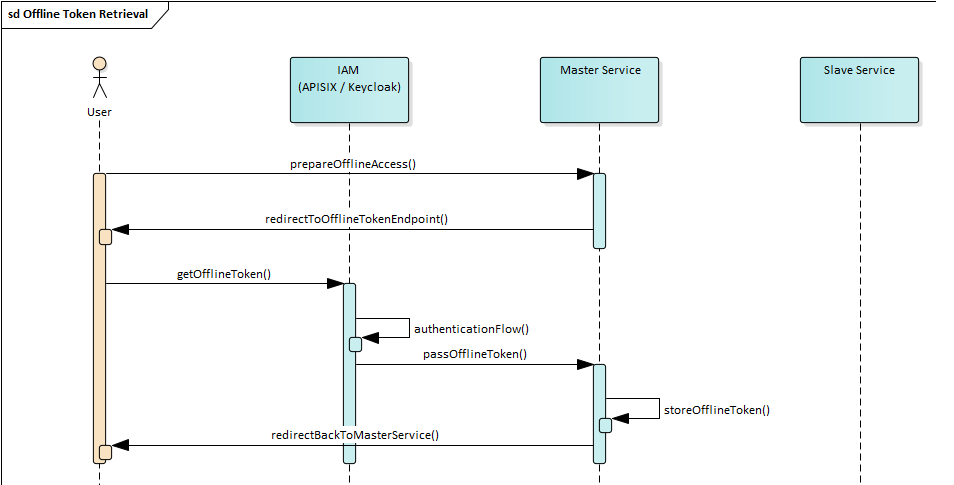
Note that the master service may use other mechanisms than redirection to access the offline token retrieval endpoint. E.g., a form could be submitted to the endpoint, and the endpoint itself could present a confirmation page.
Note that the diagram is simplified (i.e., inaccurate) in the sense that it omits the user’s client, treats the IAM as a single service and neglects that actually all communication between the user and the master service passes through APISIX.
Offline Token Use⚓︎
At some point, a service that possesses an offline token may want to use it for accessing another service.
The following diagram sketches the use of the offline token. The user
is not involved here any more. Instead, the process is initiated by the
master service. It loads the offline token it previously stored and
exchanges it for an access token via Keycloak’s token endpoint using
the refresh_token grant. It then calls some action on the slave
service with the access token attached.
The slave service validates the token via Keycloak, does something useful
and sends a response to the master service.
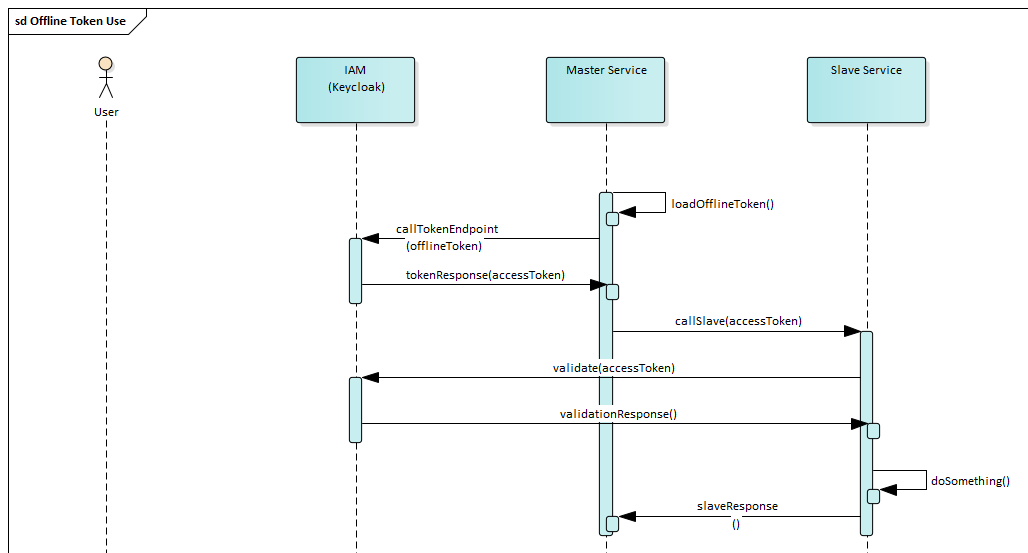
Note that the master service may optionally use token exchange to up- or downscope the access token before passing it to the slave service. This is not reflected in the diagram.
Approach 2: Token Passing⚓︎
The simplest and traditional way to implement delegated access with authorization in OAuth is to pass an already existing access token from the calling (master) service to the called (slave) service. This means that all services in the call chain effectively rely on the same access token. This approach is also known as “Poor Man’s Delegation”.
This only works if the initial access token already addresses all services as its audience that may be invoked directly or indirectly. So the token must have a broad audience and allows the involved services to call one another without any restrictions.
E.g., if the user calls service A, which needs to call services B and C to fulfil the request, the access token’s audience must include A, B and C. However, such a token does not only allow the user to call A and A to call B and C, but it also allows B to call A and C and C to call A and B. So e.g. a malicious service C would be able to call A in order to do evil things.
Hence this approach is not perfect from a security point of view, but it is easy to implement and usually acceptable if security demands are moderate. Therefore (and also due to a lack of viable alternatives) we initially used it as the standard approach.
Approach 3: Token Exchange⚓︎
Token exchange is a somewhat more sophisticated approach for delegated access than simple token passing. It allows exchanging access tokens for tokens of a different type, with different audience and/or with different scopes. This allows improving security by limiting the scope of tokens passed to other services. The ability to obtain tokens of a different type may also be useful for some EOEPCA scenarios. See this issue for more information.
Token exchange had been around as a preview feature in Keycloak for a while and has meanwhile become a fully supported feature called “Standard Token Exchange” since Keycloak 26.2.
Note that the “Standard Token Exchange” feature still has limitations. The main limitation is that it is only able to exchange tokens within a single existing user session. This leads to the following implications:
- Access tokens can be exchanged for access tokens with extended or reduced scopes and/or reduced audience. By using protocol mappers in conjunction with scopes, most token details can be adapted this way.
- Access tokens can be exchanged for refresh tokens if the client allows this and the token does not belong to an offline session.
- Standard Token Exchange does not support offline tokens. However, access tokens obtained from an offline session can still be exchanged for adapted access tokens (but not for refresh tokens).
- Standard Token Exchange does not support tokens from external IdPs. However, in conjunction with other mechanisms like JWT Authorization Grant, it is also useful in a federated context.
- Standard Token Exchange does not support impersonation and user delegation use cases.
More details about the capabilities of the Standard Token Exchange feature and the reasoning behind them can be found in the Keycloak issue.
The discussion and progress regarding implementation of the delegation feature is tracked by this Keycloak issue.
More information about the potential to use Standard Token Exchange in the context of EOEPCA can be found in a separate document.