Resource Discovery Architecture⚓︎
See also the Detailed Resource Discovery Design
Overview⚓︎
Resource Discovery provides a catalogue that maintains metadata for the resources held within a platform, and also supports platform federation by maintaining records to resources in other platforms.
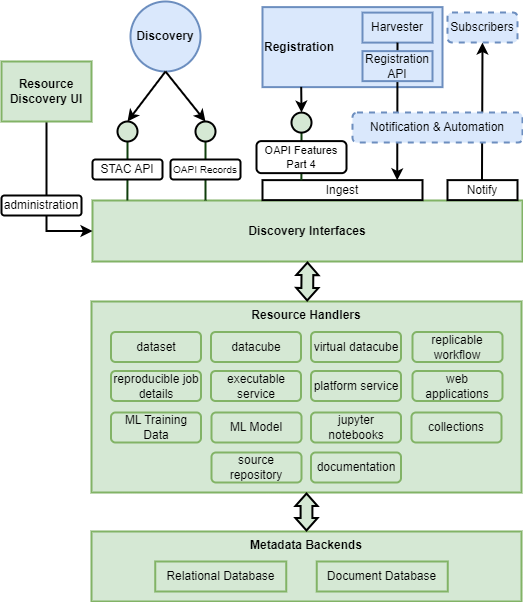
Components⚓︎
The Resource Discovery design should follow a modular approach that is extensible through components that implement specific capabilities.
Discovery Interfaces⚓︎
Extensible set of APIs to support search and discovery.
Resource Discovery should present search and browse interfaces. For interoperability these interfaces should be based on open standards:
Metadata Backends⚓︎
Extensible set of backends in which to persist and query the metadata.
The Resource Discovery building block should establish separation between its service-layer, and its data storage layer – to facilitate the integration of alternative database technologies, such as PostGIS, ElasticSearch, etc. This allows the Resource Discovery building-block to be flexible for different platform requirements for scalability and resilience – and to facilitate integration in existing platform environments.
Resource Handlers⚓︎
Extensible set of resource types to be handled.
The initial set of resource types is defined in section Resource Types – the handlers for which should be implemented within a an extensible approach through which future needs can be met.
Resource Discovery UI⚓︎
Web-enabled UI providing administrative access to the capabilities of the Resource Discovery BB.
Metadata Registration⚓︎
Resource Discovery integrates with the Notification & Automation BB to receive metadata additions/updates and to raise notification events to interested subscribers – such as for data-driven systematic processing.
In addition, Resource Discovery provides an API interface for direct registration of resources – via OGC API Features Part 4 (Create, Replace, Update and Delete [Transactions]) [RD10].
Best Practice⚓︎
Resource Discovery shall maintain metadata in accordance with industry best practice, including: